
Fractional Laser
Teaching Your Skin to Rebuild Itself
How controlled laser energy stimulates collagen, remodels damaged tissue and helps your skin regenerate from within
Your skin is constantly rebuilding
Fine lines appear. Pores become more visible. Sun exposure leaves its mark. Scars change the texture of the skin. Collagen gradually becomes less abundant and less organised.
It’s easy to look at these changes as permanent.
But skin is living tissue.
It is constantly responding to its environment, repairing damage and remodelling the extracellular matrix that gives it structure. Fractional laser works with this biological capacity for renewal.
Instead of filling a line, freezing a muscle or covering an imperfection, we create a precisely controlled stimulus within the skin and allow the body’s own repair mechanisms to take over.
The treatment happens in minutes.
The remodelling continues long after you leave the studio.
What Does "Fractional" Laser Actually Mean?
Imagine treating a lawn.
You could dig up the entire surface and wait for everything to grow back.
Or you could aerate it — creating thousands of tiny channels while leaving most of the surrounding lawn intact.
Fractional laser works on a similar principle.
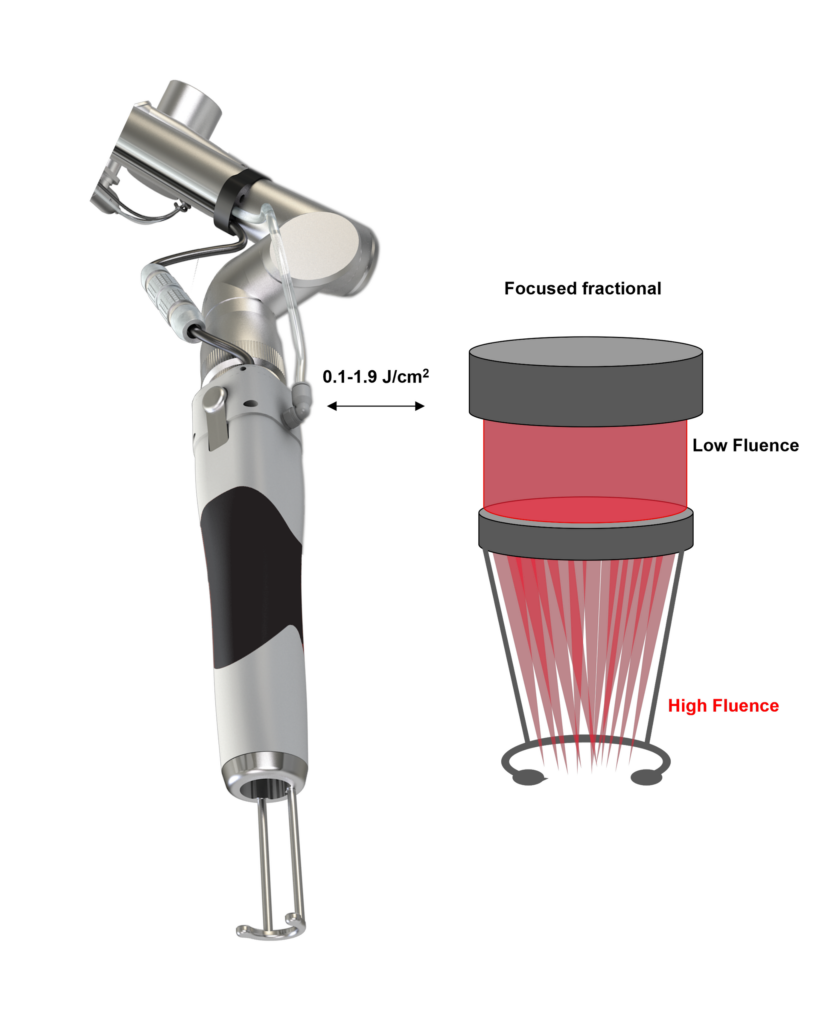
Instead of treating the entire skin surface uniformly, the laser divides its energy into an array of microscopic treatment zones. These tiny columns are surrounded by untreated tissue.
That surrounding healthy tissue matters.
It provides a reservoir of viable cells that can rapidly participate in repair, which is one reason fractional technology can stimulate significant remodelling while reducing the recovery burden associated with traditional full-field resurfacing.
This concept is known as fractional photothermolysis.
And it changed laser skin resurfacing.
What Happens Beneath the Surface?
This is where fractional laser becomes particularly interesting.
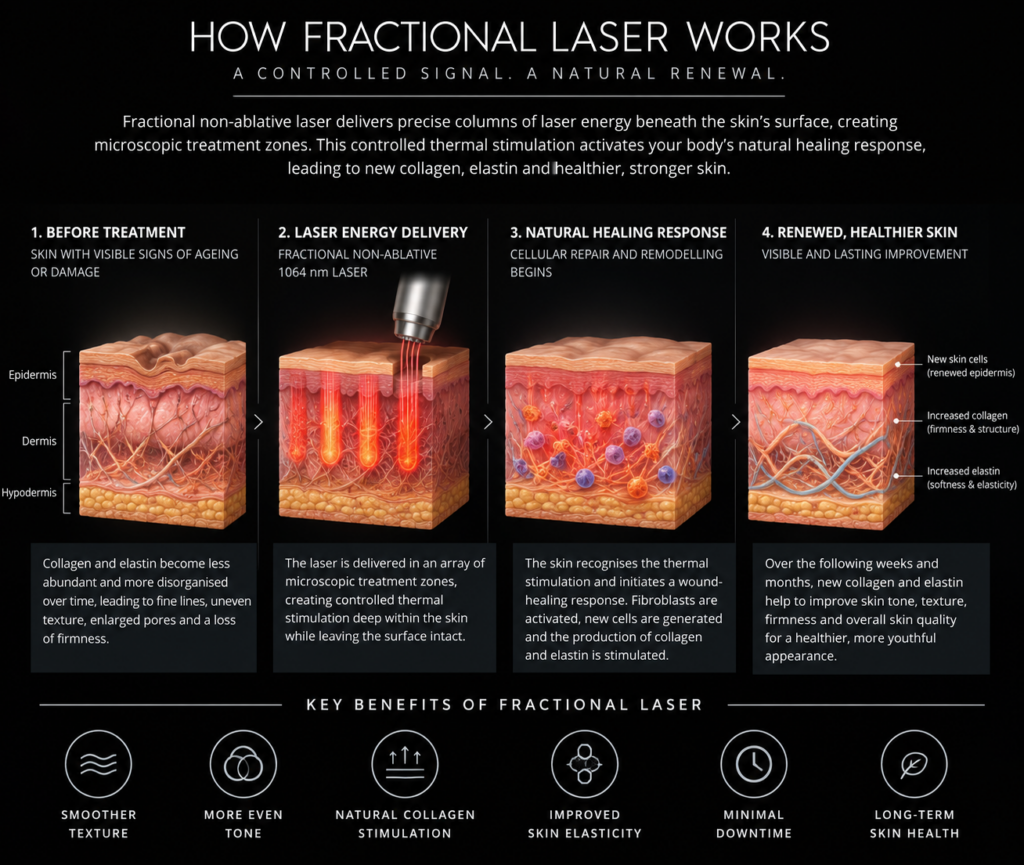
Those microscopic treatment zones create controlled thermal stimulation within the skin, triggering a natural wound-healing and remodelling response without ablating the surface.
Your body recognises that injury and responds exactly as it was designed to: repair it.
A cascade of wound-healing activity begins. Fibroblasts become involved in rebuilding the extracellular matrix, damaged tissue is remodelled, and new structural proteins are produced.
Collagen is a major part of that process.
Research into fractional resurfacing shows that controlled dermal injury can stimulate collagen remodelling and neocollagenesis — the formation of new collagen. Reviews of the technology describe improvements in photoaged skin, texture, fine wrinkling and scarring as this remodelling process unfolds.
More recent research examining the molecular effects of fractional ablative laser has also identified sustained changes in collagen associated with the wound-healing and remodelling response.
In simple terms:
The laser doesn’t manufacture younger-looking skin. Your body does.
The laser provides the signal.
Why Collagen Matters
Collagen forms much of the structural framework of the dermis.
Think of it as the scaffolding beneath the visible surface of your skin.
As that architecture changes with age, UV exposure, inflammation, injury and scarring, the effects gradually become visible:
- fine lines and wrinkles
- enlarged or more noticeable pores
- uneven texture
- reduced firmness
- acne and other scars
- changes associated with photodamage.
Fractional laser creates an opportunity for that underlying structure to be remodelled rather than simply disguising what is happening on the surface.
Research into fractional photothermolysis describes the removal and remodelling of damaged extracellular matrix and renewed fibroblast activity, including production of collagen, elastin and other components of the skin’s supporting matrix.
That’s why we think of fractional laser as regenerative skin rejuvenation.
Not All Fractional Lasers Are the Same
“Fractional” describes how laser energy is delivered to the skin, rather than a single type of laser.
Fractional technologies can be ablative or non-ablative. Ablative fractional lasers create microscopic columns in which tissue is vaporised or removed.
Non-ablative fractional lasers, like the technology we use at MorphIUs, deliver controlled thermal energy into microscopic treatment zones while leaving the surface of the skin intact.
Because only a fraction of the skin is treated at any one time, each microscopic treatment zone is surrounded by unaffected tissue. This supports a rapid healing response while the controlled thermal stimulus initiates collagen remodelling within the skin.
The objective isn’t to remove the surface of your skin. It’s to stimulate repair beneath it.
That makes non-ablative fractional treatment particularly suited to the MorphIUs approach: creating enough controlled stimulus to encourage meaningful regeneration while preserving skin integrity and minimising unnecessary trauma.
What Can Fractional Laser Improve?
Fractional resurfacing has been studied across a broad range of skin concerns.
Depending upon the technology and treatment parameters used, research has reported improvements in concerns including photoaging, fine lines, uneven pigmentation, textural irregularities and acne or surgical scarring.
At MorphIUs, our skin rejuvenation philosophy isn’t about chasing an artificially flawless face.
We are interested in skin quality.
- Texture.
- Tone.
- Resilience.
- Softness.
- Structural integrity.
We stimulate your skin to become healthier and more vital.
That makes fractional laser particularly aligned with clients who want visible improvement without relying on fillers or treatments designed primarily to alter facial movement or volume.
The Other Reason We Love Fractional Laser: FracTatt
Fractional technology also plays another important role at MorphIUs – Tattoo removal.
Traditional laser tattoo removal focuses primarily on pigment. Laser energy is absorbed by tattoo ink, fragmenting pigment so that the body can gradually clear it.
Our FracTatt protocol takes a broader view.
Before targeting the tattoo pigment with our Q-switched laser, we use fractional laser to create microscopic channels through the treatment area. In our existing FracTatt protocol, those channels are used to help vent the immediate tissue reaction while simultaneously stimulating a repair response in the skin.
That distinction is important to us.
We’re not only asking: “How do we remove the ink?”
We’re also asking: “What condition will the skin be in when we’re finished?”
Tattoo Removal Shouldn't Sacrifice the Skin
This becomes particularly important when we’re treating someone who has already experienced aggressive tattoo removal elsewhere.
Scar tissue can change the architecture of the skin. In some clients referred to MorphIUs after previous treatment complications, we’ve seen residual ink sitting beneath visibly damaged or scarred tissue.
Our approach in these situations is not simply to keep increasing the energy directed at the pigment. Instead we focus attention on the skin as our first priority.
Fractional treatment can be used as part of a strategy aimed at remodelling scarred tissue while continuing the tattoo removal journey — something we’ve already incorporated into complex cases at MorphIUs.
It reflects a principle that runs through everything we do:
Protect the skin you’re trying to reclaim.
Then We Support the Recovery
Laser creates the stimulus.
Healing creates the result.
That’s why the treatment itself is only one part of our approach.
At MorphIUs, we follow our laser treatments with red and near-infrared light therapy as part of our recovery protocol.
Photobiomodulation is being actively investigated alongside fractional laser because of its potential influence on tissue recovery and collagen regeneration. A 2025 preclinical study, for example, found improved collagen regeneration and recovery when photobiomodulation was combined with fractional CO₂ treatment compared with fractional laser alone, although this was an animal study and shouldn’t be treated as direct proof of equivalent clinical outcomes in humans.
It’s an emerging area of research that closely reflects our philosophy:
stimulate intelligently, then create the conditions for recovery.
Regeneration, Not Perfection
There is a strange contradiction in modern aesthetics.
We talk constantly about “anti-ageing” while living in bodies that are designed to age.
At MorphIUs, we’re not particularly interested in fighting biology.
We’re interested in supporting it.
Fractional laser appeals to us because the treatment doesn’t depend upon pretending time hasn’t passed.
It works by engaging one of the body’s most fundamental abilities: repair.
We create thousands of microscopic signals.
Your skin receives the message.
Fibroblasts activate. Collagen remodels. Tissue reorganises. Healing unfolds.
And gradually, the surface begins to reflect what has been happening underneath.
Not a modified face. Not a frozen expression. Not perfection.
Your skin — renewed.
Ready to Discover What Your Skin Can Do?
Every person’s skin has a different history.
Sun exposure, scarring, pigmentation, age, previous treatments, health and your objectives all influence what an appropriate rejuvenation plan looks like.
That’s why we begin with a Morphogenesis Consultation.
We’ll assess your skin, talk honestly about what fractional laser can and can’t achieve, and develop a treatment strategy designed around your skin rather than a generic beauty ideal.
Rejuvenation doesn’t have to mean changing who you are.
Sometimes it’s simply about giving your skin the right signal to begin rebuilding.
Begin your Morphogenesis.
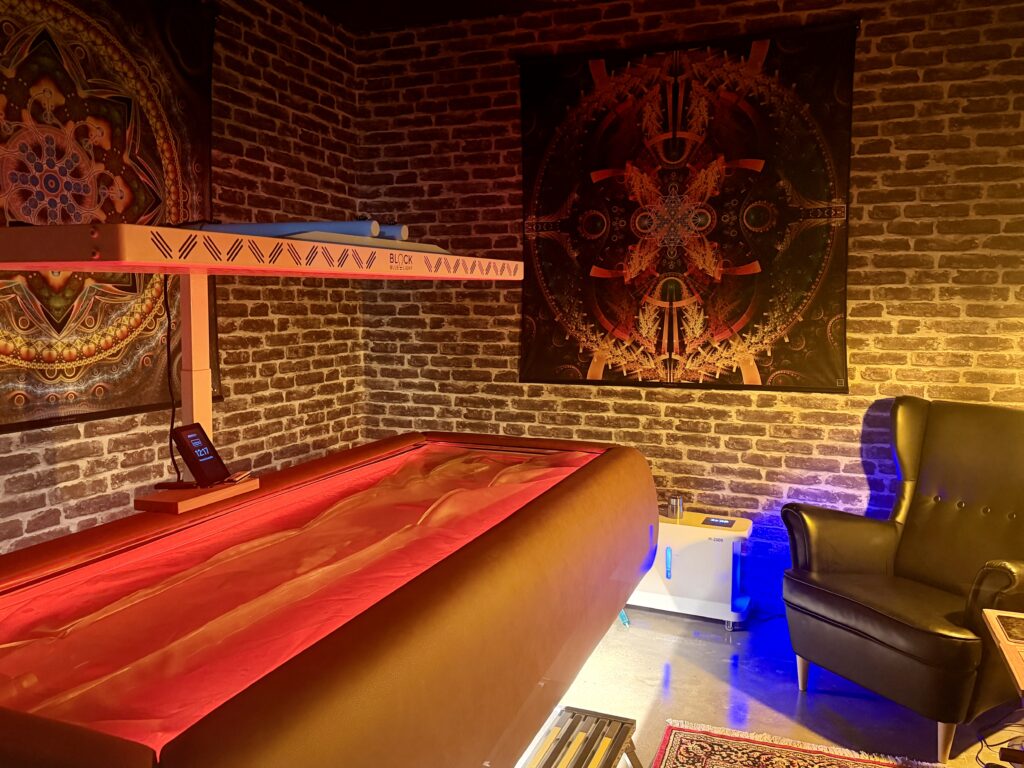
Our Trinity Recovery Stack—including Red Light Therapy, Molecular Hydrogen and Zerobody Dry Float Therapy—has been designed to support your natural healing process alongside your laser journey.
Explore our laser skin rejuvenation and tattoo removal services. Learn more about each treatment and how they can support your transformation journey using the Nine Pillars as your compass.