
Why Laser Wavelength Matters More Than Laser Brand
How Wavelength Selection Makes the Difference Between Average and Exceptional Tattoo Removal
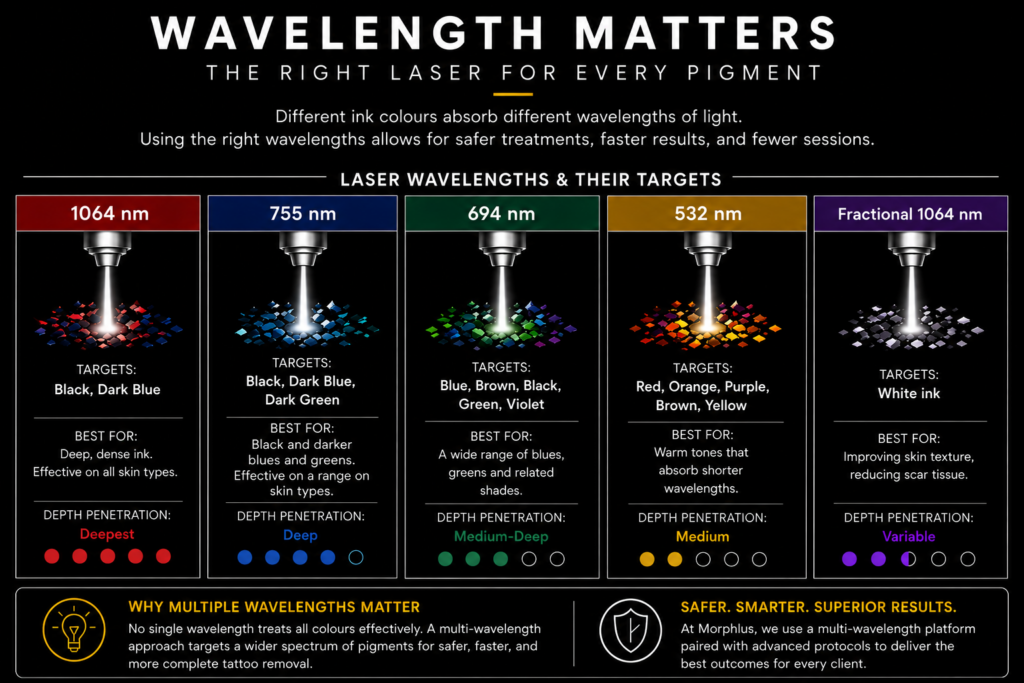
The best tattoo removal laser isn't necessarily the newest or the Fastest. It's the one that produces the right colour of light.
When most people begin researching tattoo removal, they quickly become overwhelmed.
Every clinic claims to have the latest technology.
“Pico.”
“Ultra-fast.”
“Medical grade.”
“The world’s most advanced laser.”
But very few explain the one thing that really determines whether your tattoo fades beautifully, or stubbornly refuses to budge.
Laser wavelength.
At MorphIUs, we think every client should understand the science behind their treatment. Because once you understand how laser light interacts with tattoo ink, you’ll know exactly what questions to ask before trusting anyone with your skin.
The Secret Most Clinics Don't Explain
To clear tattoo ink, the laser must produce a very specific wavelength of light.
Different tattoo pigments match to different wavelengths.
If the wavelength isn’t a match, the pigment can’t absorb that wavelength efficiently and very little happens.
That’s why some tattoos fade quickly while others appear to stop responding altogether.
It isn’t always the tattoo.
Sometimes it’s the wrong wavelength.
Your Tattoo Probably Isn't One Colour
Even tattoos that appear black can be surprisingly complex.
Professional black inks often contain:
- Carbon black
- Blue undertones
- Grey wash
- Layered pigments
What appears to be one colour can actually behave like several different pigments during laser treatment.
This is why experienced practitioners assess each tattoo individually rather than simply using the same settings every time.
How Light Removes Ink
Tattoo pigments absorb certain colours of light while reflecting others.
When the correct wavelength reaches the pigment:
- the ink absorbs the laser energy
- the pigment rapidly heats
- the particles fracture into much smaller fragments so your immune system can dissolve the particles and gradually remove those fragments through the lymphatic system.
This is why laser treatment doesn’t remove ink immediately.
The laser prepares the ink.
Your body completes the process.
If you’d like to understand that part of the journey in more detail, read our companion guide:
Why Different Colours Need Different Wavelengths
Imagine trying to open every lock in your house using a single key.
Some doors might open. Most won’t.
Tattoo pigments work in exactly the same way.
Each colour responds best to particular wavelengths of laser light.
At MorphIUs, our Quanta Q-Plus C MT EVO provides three true native wavelengths, allowing us to select the most appropriate tool for each pigment rather than asking one wavelength to do everything.
1064 nanometres
Ideal for:
- black
- charcoal
- dark blue
Because these pigments absorb this wavelength extremely well.
532 nanometres
Best suited for:
- red
- orange
- brown
- yellow
- warm pigments and autumn colours
These colours respond very differently from black, requiring an entirely different wavelength for effective treatment.
694 nanometres Ruby
Particularly valuable for difficult pigments including:
- green
- teal
- turquoise
- sky blue
These colours are often where many tattoo removal journeys slow down.
The ability to treat them with an appropriate wavelength can make a significant difference to overall clearance.
Why Black Usually Fades First
People often notice that the black sections of their tattoo disappear long before the coloured areas.
There’s a simple scientific reason.
Black pigments absorb a broad range of wavelengths.
They’re relatively easy for many laser systems to target.
Green, turquoise and certain blues are far more selective.
Without the appropriate wavelength, they can remain surprisingly resistant, even after multiple treatments.
Why Green Is Famous for Being Difficult
Ask almost any tattoo removal practitioner about challenging colours and green usually appears near the top of the list.
That’s because green reflects much of the light produced by many tattoo lasers.
If the pigment reflects the energy instead of absorbing it, very little fragmentation occurs.
Clients sometimes assume:
“My tattoo just isn’t fading.”
In reality, it may simply need a wavelength better matched to that pigment.
Cosmetic Pigments
Some cosmetic pigments present an even greater challenge.
Certain flesh-toned cosmetic inks may contain titanium compounds.
Rather than breaking apart, these pigments can sometimes undergo colour changes when exposed to laser treatment.
This is one reason cosmetic tattoo removal requires careful assessment and honest discussion before treatment begins.
White: The Greatest Challenge
White pigments is particularly resistant because white reflects much of the available laser energy instead of absorbing it efficiently.
The fractionated laser used in a FracTatt tattoo removal treatment, has been shown to clear white ink through a different mechanism of action.
Learn more about FracTatt in the article linked below:
The Pico Myth
One of the biggest misconceptions in tattoo removal is that “Pico is better.”
The reality is more nuanced.
“Pico” refers to the length of the laser pulse duration.
“Wavelength” determines which pigments can actually absorb that energy.
These are completely different characteristics.
A picosecond laser with the wrong wavelength will struggle to treat certain pigments.
A nanosecond laser with the correct wavelength can produce excellent clearance.
Both pulse duration and wavelength matter.
But if the pigment cannot absorb the wavelength being delivered, shortening the pulse alone cannot solve that problem.
This is why experienced practitioners look beyond marketing terminology and focus on matching the appropriate wavelength to the tattoo being treated.
Check out our article on Pico lasers here:
The Machine Doesn't Make the Decisions
Even the most sophisticated laser is only a tool.
The real expertise lies in knowing:
- which wavelength to choose
- what energy level to use
- what spot size is appropriate
- when to alter the protocol
- when to introduce fractionated treatment
- when to wait longer between sessions
- how to support recovery.
These decisions come from experience, observation and clinical judgement.
There is no “one size fits all”.
Why MorphIUs Chose Three Native Wavelengths
When we selected our technology, we phased out the industry noise, to focus on key differentiators.
We wanted versatility.
Our Quanta system allows us to work with:
- 1064 nm for black and dark pigments
- 532 nm for reds and autumn colours
- 694 nm Ruby for resistant greens and blues
Combined with our FracTatt protocol, which prepares the skin before targeting the pigment, this allows us to tailor treatment to the tattoo rather than forcing every tattoo through the same protocol.
Choosing the Right Clinic
Instead of asking:
“Do you have a Pico laser?”
Consider asking:
- Which wavelengths do you have?
- How do you choose which wavelength to use?
- Can you treat resistant green and blue pigments?
- How do you adapt your treatment as my tattoo changes?
- How do you protect my skin while removing the ink?
Those questions reveal far more about a clinic’s expertise than the name printed on the machine.
The Bottom Line
Successful tattoo removal isn’t about finding the most celebrated laser.
It isn’t about chasing the newest technology.
It’s about understanding the relationship between light, pigment, skin, and healing.
The best clinics don’t simply own advanced equipment.
They know how—and when—to use every wavelength available.
Because every tattoo is different.
Every pigment behaves differently.
And every client deserves a treatment specifically tailored for their skin and their story.
Our Trinity Recovery Stack—including Red Light Therapy, Molecular Hydrogen and Zerobody Dry Float Therapy—has been designed to support your natural healing process alongside your laser journey.


Explore our laser skin rejuvenation and tattoo removal services. Learn more about each treatment and how they can support your transformation journey using the Nine Pillars as your compass.